

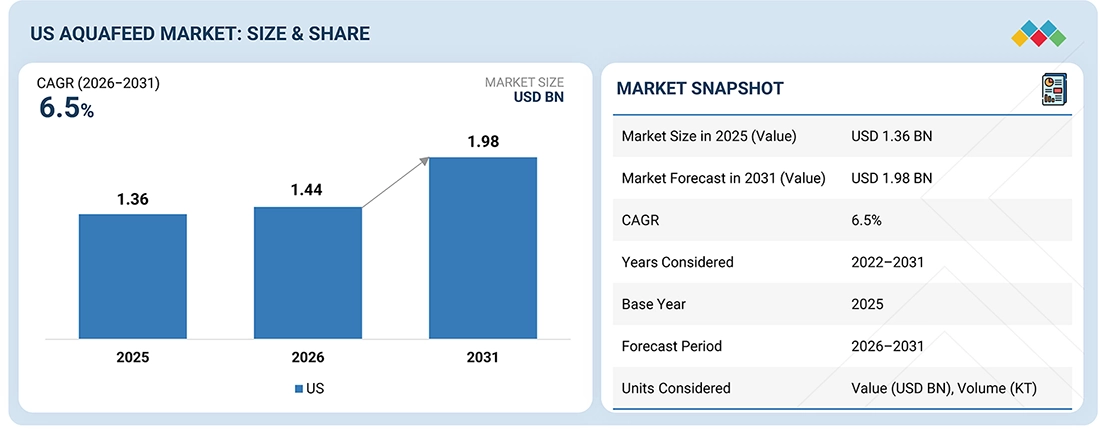
The US Aquafeed Market is entering a steady growth phase, driven by rising seafood consumption, expanding aquaculture operations, and increasing demand for efficient, high-performance feed solutions. The market is projected to expand from USD 1.44 billion in 2026 to USD 1.98 billion by 2031, registering a CAGR of 6.5% during the forecast period.
US Aquafeed Market Overview
The growth of the US aquafeed industry is strongly linked to the rapid expansion of commercial fish farming and aquaculture production systems. As consumer demand for seafood continues to rise, producers are under pressure to improve productivity, reduce mortality rates, and optimize feed utilization.
Modern aquaculture systems increasingly rely on scientifically formulated compound aquafeed, which ensures consistent nutrition, faster growth, and improved survival rates across aquatic species such as salmon, trout, catfish, and tilapia.
Key market drivers include:
- Rising seafood consumption in the US
- Expansion of intensive aquaculture farming systems
- Demand for improved feed conversion efficiency
- Increasing use of automated feeding technologies
- Focus on sustainable and high-yield production systems
Feed quality plays a critical role in determining fish health, growth performance, and farm profitability, making aquafeed an essential input in the aquaculture value chain.
Download PDF Brochure: https://www.marketsandmarkets.com/pdfdownloadNew.asp?id=3345366
Amino Acids Dominate the Additives Segment
Within the additives category, amino acids represent the largest share of the US aquafeed market during the forecast period.
Amino acids such as lysine, methionine, and threonine are widely used because they:
- Improve feed conversion efficiency
- Support faster and more uniform growth
- Enhance protein utilization in aquatic animals
- Strengthen muscle development and overall health
Since aquaculture producers prioritize measurable performance outcomes—such as growth rate and survival—amino acid additives remain a standard component in commercial feed formulations. Their proven effectiveness ensures continued dominance in the additives segment.
Grower Stage Leads in Growth Potential
The grower phase of the aquaculture lifecycle is expected to be the fastest-growing segment in the US aquafeed market.
This stage is critical because fish and shrimp experience their highest weight gain during this period. As a result, feed consumption is significantly higher compared to the hatchery and starter phases.
Key factors driving this segment include:
- Longer duration of the grower phase
- High feed intake and stocking density
- Focus on improving feed conversion ratios (FCR)
- Increasing pressure to reduce time-to-market
- Rising feed cost optimization strategies
To maximize profitability, producers are investing in nutritionally balanced grower diets that ensure consistent weight gain and efficient resource utilization. This makes the grower segment a major driver of overall aquafeed demand in the US.
Request Sample Pages: https://www.marketsandmarkets.com/requestsampleNew.asp?id=3345366
Crustaceans Segment Shows Strong Growth Momentum
The crustaceans segment, particularly shrimp farming, is expected to register the highest CAGR in the US aquafeed market during the forecast period.
According to the USDA 2023 Census of Aquaculture, the US has 51 saltwater shrimp farms, primarily located in Florida and Texas, with additional inland operations in states such as Iowa, Kentucky, Minnesota, and Missouri.
Shrimp remains one of the most consumed seafood products in the US:
- Accounts for ~38% of total seafood consumption
- Average consumption: ~5.5 pounds per person annually
- Total national consumption exceeds 1.5 billion pounds per year
- Nearly 90% of shrimp is imported
This heavy import dependence creates significant opportunities for domestic aquaculture expansion.
As inland and coastal shrimp farms scale up operations—especially using Recirculating Aquaculture Systems (RAS)—the demand for high-quality formulated aquafeed continues to rise. Since crustaceans rely entirely on external feed sources, growth in shrimp farming directly translates into higher aquafeed consumption.
Leading US Aquafeed Companies:
The US aquafeed market is highly competitive, with a mix of global and domestic players focusing on innovation, sustainability, and feed efficiency.
Key companies operating in the market include:
- Cargill (US)
- Archer Daniels Midland (ADM) (US)
- dsm-firmenich (Switzerland)
- Nutreco (Netherlands)
- Alltech (US)
- Purina Animal Nutrition LLC (US)
- Adisseo (France)
- Kemin Industries, Inc. (US)
- Darling Ingredients (US)
- Rangen LLC (US)
- The Scoular Company (US)
- Novus International (US)
- Norel Animal Nutrition (Spain)
- Kent Nutrition Group (US)
- Beneo (Germany)
These companies are investing in advanced feed formulations, functional additives, and sustainable protein sources to strengthen their market position.