
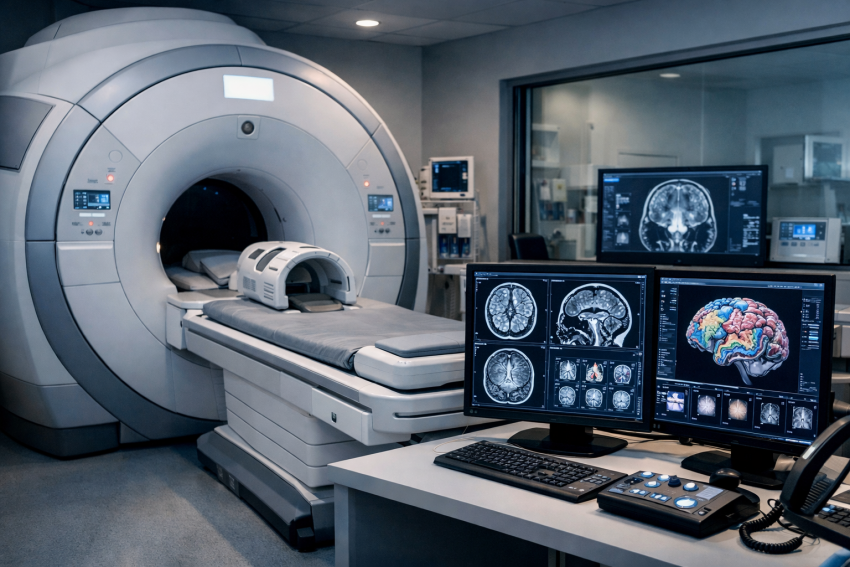
Functional Magnetic Resonance Imaging (fMRI), commonly referred to as Brain MRI, has emerged as one of the most powerful non-invasive imaging technologies in modern medicine. By enabling real-time visualization of brain activity, functional MRI systems are transforming how clinicians diagnose neurological disorders, researchers study cognition, and healthcare providers plan treatments. This blog explores how functional/brain MRI systems work, their applications, benefits, and future trends—optimized for both readers and search engines.
What is Functional MRI (fMRI)?
Functional MRI (fMRI) is an advanced imaging technique that measures and maps brain activity by detecting changes in blood flow. Unlike traditional MRI, which focuses on anatomical structures, fMRI provides functional insights into how different regions of the brain respond to stimuli or tasks.
It operates on the principle of the Blood Oxygen Level Dependent (BOLD) signal. When a specific part of the brain is active, it consumes more oxygen. The MRI scanner detects these changes, allowing clinicians and researchers to visualize active brain regions in real time.
The global Functional/Brain MRI System market, valued at USD 0.79 billion in 2025, stood at USD 0.85 billion in 2026 and is projected to advance at a resilient CAGR of 8.0% from 2026 to 2031, culminating in a forecasted valuation of USD 1.25 billion by the end of the period.
Download PDF Brochure:
https://www.marketsandmarkets.com/pdfdownloadNew.asp?id=115411320
How Functional MRI Systems Work
Functional MRI systems rely on strong magnetic fields, radio waves, and sophisticated software algorithms to generate high-resolution images.
Key Components of fMRI Systems:
- Magnet System (1.5T, 3T, or higher): Generates a powerful magnetic field for imaging
- Gradient Coils: Enable spatial encoding of signals
- RF (Radiofrequency) Coils: Transmit and receive signals
- Data Processing Software: Converts signals into functional brain maps
Step-by-Step Process:
- The patient is placed inside the MRI scanner.
- The scanner measures baseline brain activity.
- The patient performs specific tasks (e.g., speaking, moving fingers).
- Changes in blood oxygen levels are recorded.
- Software generates activation maps highlighting active brain areas.
Applications of Functional Brain MRI Systems
Functional MRI systems are widely used across clinical, research, and therapeutic domains.
- Neurological Disorder Diagnosis
- Alzheimer’s disease
- Parkinson’s disease
- Epilepsy
- Stroke assessment
fMRI helps detect abnormal brain activity patterns early, improving diagnosis accuracy.
- Pre-Surgical Brain Mapping
Before brain surgeries, especially tumor removal, fMRI identifies critical regions responsible for:
- Speech
- Motor function
- Memory
This minimizes surgical risks and preserves essential brain functions.
- Cognitive and Behavioral Research
Researchers use fMRI to study:
- Memory and learning
- Decision-making processes
- Emotional responses
- Brain connectivity
This has significantly advanced neuroscience and psychology.
- Mental Health Analysis
Functional MRI plays a growing role in understanding:
- Depression
- Anxiety disorders
- Schizophrenia
It helps identify altered neural pathways and supports personalized treatment approaches.
- Brain-Computer Interface (BCI) Development
fMRI is used in developing advanced brain-machine interfaces, enabling communication for patients with severe disabilities.
Benefits of Functional MRI Systems
Non-Invasive and Safe
Unlike CT scans or PET imaging, fMRI does not use ionizing radiation, making it safer for repeated use.
High Spatial Resolution
Provides detailed images of brain structures and activity.
Real-Time Brain Activity Monitoring
Enables dynamic tracking of neural responses.
Versatility
Applicable across multiple disciplines—from neurology to psychiatry and cognitive science.
Challenges and Limitations
Despite its advantages, functional MRI systems have some limitations:
- High Cost: Equipment and maintenance are expensive
- Sensitivity to Motion: Even slight patient movement can affect results
- Complex Data Interpretation: Requires specialized expertise
- Limited Temporal Resolution: Slower compared to EEG
Technological Advancements in fMRI Systems
The field of brain imaging is evolving rapidly with innovations that enhance performance and accessibility.
- High-Field MRI (7 Tesla and Beyond)
Offers ultra-high resolution imaging, enabling detailed brain mapping.
- AI Integration
Artificial Intelligence is improving:
- Image reconstruction
- Noise reduction
- Automated diagnosis
- Portable MRI Systems
Emerging compact MRI technologies aim to increase accessibility in remote or emergency settings.
- Multimodal Imaging
Combining fMRI with EEG or PET provides comprehensive insights into brain function and structure.
Future Trends in Functional Brain Imaging
The future of functional MRI systems is promising, with developments focused on precision medicine and personalized healthcare.
- Neurofeedback Therapy: Using fMRI to train patients to regulate brain activity
- Early Disease Detection: Identifying neurological disorders before symptoms appear
- Cloud-Based Imaging Platforms: Enabling remote diagnostics and collaboration
- Integration with Wearables: Expanding brain monitoring capabilities
Inquire Before Buying:
https://www.marketsandmarkets.com/Enquiry_Before_BuyingNew.asp?id=115411320
Conclusion
Functional/Brain MRI systems have revolutionized how we understand and diagnose brain function. From detecting neurological disorders to advancing cognitive research, fMRI continues to push the boundaries of medical science. As technology evolves—with AI, high-field imaging, and portable solutions—functional MRI systems will play an even greater role in shaping the future of healthcare and neuroscience.