
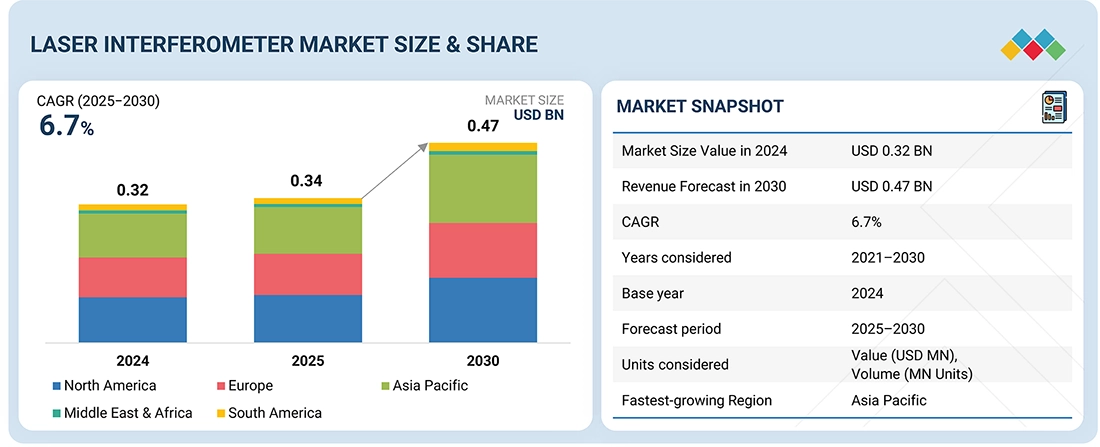
The global Laser Interferometer Market is set to undergo significant transformation by 2030, driven by rapid technological advancements, increasing demand for ultra-precision measurement, and the widespread adoption of automation and digital manufacturing practices. As industries across the globe strive for higher efficiency, tighter tolerances, and improved product quality, laser interferometers are becoming indispensable tools in both industrial and research environments. The future of this market will be shaped by emerging trends that enhance system capabilities, expand application areas, and redefine how precision measurement is integrated into modern workflows.
One of the most prominent trends influencing the market is the continued advancement of high-precision manufacturing technologies. Industries such as semiconductors, aerospace, and advanced electronics are pushing the boundaries of miniaturization and complexity, requiring measurement solutions capable of nanometer-level accuracy. Laser interferometers are evolving to meet these demands by incorporating advanced optical designs, improved laser stability, and enhanced resolution. By 2030, these systems are expected to deliver even higher levels of precision, enabling manufacturers to achieve unprecedented levels of accuracy in production processes.
Download PDF Brochure @ https://www.marketsandmarkets.com/pdfdownloadNew.asp?id=83973072

The integration of digital technologies and smart manufacturing concepts is another major trend transforming the laser interferometer market. As Industry 4.0 continues to gain momentum, manufacturing environments are becoming increasingly interconnected and data-driven. Laser interferometers are being integrated with digital platforms, enabling real-time data collection, analysis, and process optimization. This integration allows manufacturers to monitor performance, detect anomalies, and make data-driven decisions that improve efficiency and reduce waste. The use of digital twins and cloud-based systems is expected to further enhance the capabilities of interferometric measurement, enabling remote monitoring and predictive maintenance.
Artificial intelligence and machine learning are also playing a growing role in shaping the future of laser interferometers. These technologies are being used to enhance data processing, improve measurement accuracy, and enable predictive analytics. AI-driven algorithms can analyze large volumes of measurement data to identify patterns, detect deviations, and optimize system performance. By incorporating intelligent features, laser interferometers are evolving from passive measurement tools into active components of smart manufacturing systems. This trend is expected to drive significant innovation and create new opportunities for application across industries.
Another important trend is the increasing adoption of automation and robotics in manufacturing processes. Laser interferometers are being integrated with robotic systems to provide real-time measurement and feedback, enabling precise control of automated operations. This integration enhances productivity, reduces human error, and ensures consistent quality in high-speed production environments. As robotics and automation technologies continue to advance, the demand for high-precision measurement solutions will grow, further driving the adoption of laser interferometers.
Inquiry Before Buying @ https://www.marketsandmarkets.com/Enquiry_Before_BuyingNew.asp?id=83973072

The development of compact and portable interferometer systems is also expected to influence market growth. Traditional interferometers are often large and require controlled environments, limiting their use in certain applications. Advances in miniaturization and system design are enabling the creation of smaller, more versatile devices that can be used in a wider range of settings. Portable interferometers are particularly valuable for field applications, maintenance tasks, and on-site inspections, expanding the reach of these technologies beyond traditional laboratory and manufacturing environments.
Sustainability and energy efficiency are emerging as key considerations in the development of laser interferometer systems. As industries focus on reducing their environmental impact, there is a growing demand for energy-efficient measurement solutions. Manufacturers are developing systems that consume less power while maintaining high performance, contributing to more sustainable operations. Additionally, the use of precise measurement technologies helps reduce material waste and improve production efficiency, aligning with global sustainability goals.
The expansion of application areas is another trend shaping the future of the laser interferometer market. In addition to traditional industries, new applications are emerging in fields such as medical device manufacturing, renewable energy, and advanced materials research. For example, laser interferometers are being used in the production and inspection of solar panels, wind turbine components, and battery technologies. These new applications are broadening the market scope and creating opportunities for growth in emerging sectors.
Global investment in research and development is expected to further accelerate market transformation. Governments and private organizations are increasing funding for advanced technologies, including nanotechnology, photonics, and quantum computing. Laser interferometers play a critical role in these fields by providing the precise measurement capabilities required for experimentation and development. Increased R&D activity will drive innovation in interferometer technology and expand its applications in cutting-edge research areas.
View detailed Table of Content here – https://www.marketsandmarkets.com/Market-Reports/laser-interferometer-market-83973072.html

Despite the positive outlook, challenges such as high costs, technical complexity, and the need for skilled operators may continue to impact market adoption. However, ongoing efforts to develop user-friendly interfaces, automated calibration systems, and cost-effective solutions are expected to address these challenges. As technology becomes more accessible, a wider range of industries will be able to adopt laser interferometers, supporting market growth.
Looking ahead to 2030, the global laser interferometer market is expected to experience robust expansion, driven by the convergence of advanced technologies and increasing demand for precision measurement. The integration of AI, automation, and digital platforms will enhance system capabilities, while innovations in design and functionality will expand application possibilities. These trends will not only improve measurement accuracy and efficiency but also redefine the role of laser interferometers in modern industrial and scientific environments.
Future trends such as digital transformation, AI integration, automation, miniaturization, and sustainability are set to transform the global laser interferometer market by 2030. These developments will drive innovation, expand applications, and enhance the overall value of interferometric measurement systems. As industries continue to evolve and demand higher levels of precision and efficiency, laser interferometers will remain at the forefront of technological advancement, playing a critical role in shaping the future of precision engineering and manufacturing.