
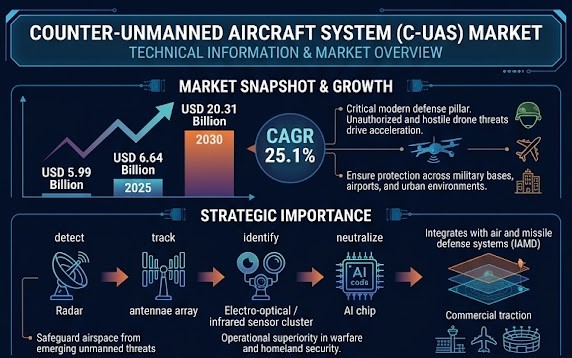
The Counter-Unmanned Aircraft System (C-UAS) Market is emerging as a vital component of global security infrastructure as drone technology becomes more widespread. The market is projected to grow from USD 6.64 billion in 2025 to USD 20.31 billion by 2030, achieving a CAGR of 25.1%. This growth is fueled by increasing concerns over drone-related threats and the need for advanced countermeasures.
As drones are used for both beneficial and malicious purposes, the demand for reliable detection and mitigation systems is rising. The Counter-Unmanned Aircraft System (C-UAS) Market is addressing these challenges by offering comprehensive solutions for airspace security.
Understanding the Strategic Importance of the Counter-Unmanned Aircraft System (C-UAS) Market
The Counter-Unmanned Aircraft System (C-UAS) Market provides critical capabilities for identifying and neutralizing unauthorized drones. These systems combine multiple technologies to deliver accurate and efficient threat response.
Their deployment across military, commercial, and public safety sectors highlights their growing importance. The Counter-Unmanned Aircraft System (C-UAS) Market is therefore essential for maintaining secure and controlled airspace.
Geopolitical Tensions 2026
The evolving geopolitical landscape in 2026 is significantly accelerating the growth of the Counter-Unmanned Aircraft System (C-UAS) Industry, as nations face rising security threats from asymmetric warfare and cross-border drone incursions. Increasing tensions across regions such as Eastern Europe, the Middle East, and the Indo-Pacific have highlighted the strategic importance of counter-drone capabilities in modern defense planning. Governments are prioritizing the deployment of advanced detection and neutralization systems to protect critical infrastructure, military installations, and urban airspaces from hostile unmanned aerial activities. This heightened threat environment is pushing defense agencies to rapidly modernize their air defense frameworks, positioning the Counter-Unmanned Aircraft System (C-UAS) Market as a vital component of national security strategies.
At the same time, geopolitical rivalries are driving significant investments in indigenous defense technologies and reducing reliance on foreign systems, further shaping the Counter-Unmanned Aircraft System (C-UAS) Market. Countries are focusing on developing integrated and interoperable solutions that align with broader multi-domain operations, ensuring readiness against increasingly sophisticated drone threats. The proliferation of low-cost drones in conflict zones and their use in surveillance, electronic warfare, and targeted attacks has intensified the urgency for scalable and adaptive countermeasures. As a result, geopolitical tensions are not only increasing demand but also fostering innovation, collaboration, and strategic partnerships within the Counter-Unmanned Aircraft System (C-UAS) Market, ultimately reshaping the global defense ecosystem.
Download Brochure Analyst-Verified Insights: https://www.marketsandmarkets.com/pdfdownloadNew.asp?id=4197284
Market Size, Forecast, and Growth Outlook of the Counter-Unmanned Aircraft System (C-UAS) Market
The Counter-Unmanned Aircraft System (C-UAS) Market is poised for substantial growth, driven by rising investments in defense modernization and increasing demand for advanced security solutions. The market is expected to reach USD 20.31 billion by 2030, up from USD 6.64 billion in 2025, reflecting a CAGR of 25.1 percent.
North America is anticipated to be the fastest-growing region in the Counter-Unmanned Aircraft System (C-UAS) Market, supported by strong defense spending, technological advancements, and regulatory developments. Europe follows as a key market, with increasing adoption of counter-drone systems driven by NATO modernization programs and regional security concerns.
The growing alignment with integrated air and missile defense systems is further accelerating the expansion of the Counter-Unmanned Aircraft System (C-UAS) Market, enabling more efficient and coordinated threat response capabilities.
Key Drivers Accelerating the Counter-Unmanned Aircraft System (C-UAS) Market
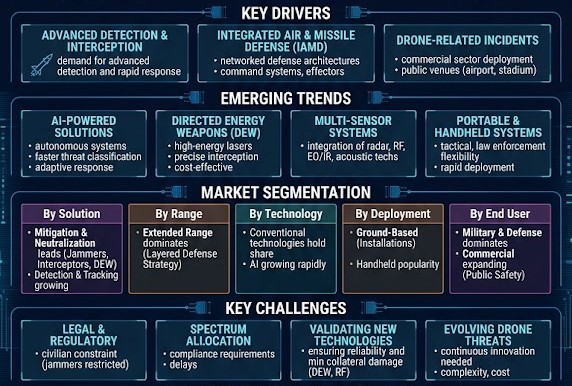
A major driver of the Counter-Unmanned Aircraft System (C-UAS) Market is the rising demand for advanced detection and interception technologies. As drone threats become more sophisticated, defense forces are investing in systems that provide real-time situational awareness and rapid response capabilities.
The shift toward integrated air and missile defense alignment is another significant driver. Governments are focusing on networked defense architectures that combine sensors, effectors, and command systems to enhance operational efficiency and interoperability.
Additionally, the increasing frequency of drone-related incidents is driving adoption across commercial sectors. Airports, public venues, and critical infrastructure facilities are deploying counter-drone solutions to mitigate security risks, further boosting the Counter-Unmanned Aircraft System (C-UAS) Market.
Emerging Trends Transforming the Counter-Unmanned Aircraft System (C-UAS) Market
The Counter-Unmanned Aircraft System (C-UAS) Market is undergoing rapid technological transformation, with a strong emphasis on AI-powered solutions and autonomous systems. AI-driven analytics are enabling faster and more accurate detection, classification, and response to drone threats.
Another key trend is the development of directed energy weapons, such as high-energy lasers, which offer precise and cost-effective interception capabilities. These technologies are reshaping the future of the Counter-Unmanned Aircraft System (C-UAS) Market.
The integration of multi-sensor systems is also gaining traction. Combining radar, RF detection, EO/IR sensors, and acoustic technologies provides a comprehensive approach to threat detection and tracking.
Furthermore, the adoption of portable and handheld counter-drone systems is increasing, particularly for tactical and law enforcement applications. These systems offer flexibility and rapid deployment, enhancing operational effectiveness.
Challenges Impacting the Counter-Unmanned Aircraft System (C-UAS) Market
Despite its strong growth potential, the Counter-Unmanned Aircraft System (C-UAS) Market faces several challenges. Legal and regulatory constraints are a major concern, particularly in civilian environments where the use of jamming and interception technologies is restricted.
Spectrum allocation and compliance requirements add complexity to system deployment, limiting the scalability of counter-drone solutions. These regulatory challenges can delay product approvals and increase operational costs.
Another significant challenge is the need to validate the effectiveness and safety of emerging technologies. Directed energy weapons and RF-based countermeasures require extensive testing to ensure reliability and minimize collateral impact.
Additionally, the evolving nature of drone threats requires continuous innovation, increasing the complexity and cost of developing advanced counter-UAS systems.
Opportunities in the Counter-Unmanned Aircraft System (C-UAS) Market
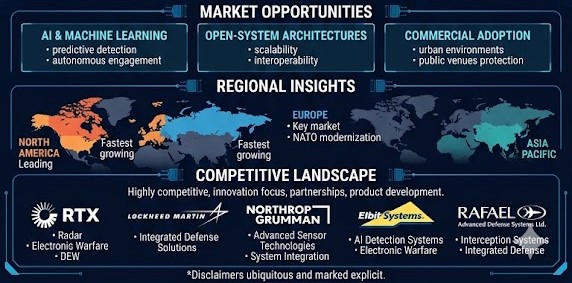
The Counter-Unmanned Aircraft System (C-UAS) Market presents significant opportunities driven by advancements in AI and machine learning technologies. These innovations enable predictive threat detection, autonomous engagement, and adaptive response mechanisms.
The growing emphasis on open-system architectures and interoperability is also creating new growth avenues. Defense organizations are seeking scalable and flexible solutions that can integrate seamlessly with existing systems.
Commercial adoption is another key opportunity. As drone usage increases in urban environments, the demand for counter-drone solutions in airports, stadiums, and critical infrastructure is expected to rise significantly.
Segment Analysis of the Counter-Unmanned Aircraft System (C-UAS) Market
The Counter-Unmanned Aircraft System (C-UAS) Market is segmented based on solution, range, technology, deployment, and end user.
The mitigation and neutralization segment leads the market, driven by the widespread adoption of jammers, interceptors, and directed energy systems. Detection and tracking solutions are also growing rapidly due to advancements in radar and AI technologies.
The extended range segment dominates the market, as defense forces prioritize long-range protection for bases and borders. These systems play a critical role in layered defense strategies.
Conventional technologies currently hold a significant share, but AI-powered systems are expected to grow rapidly, offering enhanced automation and efficiency.
Ground-based deployment leads the market, supported by large-scale installations across defense and security sites. Handheld systems are also gaining popularity for their portability and ease of use.
The military and defense segment dominates the Counter-Unmanned Aircraft System (C-UAS) Market, while the commercial sector is expanding rapidly with increasing adoption in public safety applications.
Regional Insights in the Counter-Unmanned Aircraft System (C-UAS) Market
North America leads the Counter-Unmanned Aircraft System (C-UAS) Market, driven by strong defense investments and advanced technological capabilities. The region is also witnessing increased deployment of AI-enabled counter-drone systems.
Europe is the second-largest market, supported by NATO initiatives and increasing adoption of counter-drone technologies. The region is also home to several leading solution providers.
Asia Pacific is emerging as a key growth region, with increasing investments in homeland security and defense modernization programs.
Competitive Landscape of the Counter-Unmanned Aircraft System (C-UAS) Market
The Counter-Unmanned Aircraft System (C-UAS) Market is highly competitive, with major players focusing on innovation, partnerships, and product development.
RTX
RTX is a leading player in the Counter-Unmanned Aircraft System (C-UAS) Market, offering advanced radar, electronic warfare, and directed energy solutions. Its strong global presence and technological expertise position it as a market leader.
Lockheed Martin Corporation
Lockheed Martin Corporation plays a significant role in the Counter-Unmanned Aircraft System (C-UAS) Market, providing integrated defense solutions that enhance threat detection and interception capabilities.
Northrop Grumman
Northrop Grumman is a key contributor to the Counter-Unmanned Aircraft System (C-UAS) Market, known for its advanced sensor technologies and system integration capabilities.
Elbit Systems Ltd.
Elbit Systems Ltd. offers a wide range of counter-drone solutions, including AI-driven detection systems and electronic warfare technologies, strengthening its position in the market.
RAFAEL Advanced Defense Systems Ltd.
RAFAEL Advanced Defense Systems Ltd. is recognized for its innovative counter-UAS technologies, including advanced interception systems and integrated defense solutions.
Future Outlook of the Counter-Unmanned Aircraft System (C-UAS) Market
The Counter-Unmanned Aircraft System (C-UAS) Market is expected to witness sustained growth as drone threats continue to evolve. Increasing investments in advanced detection and mitigation technologies will drive market expansion.
The integration of AI, autonomous systems, and directed energy solutions will further enhance the capabilities of counter-UAS systems. As defense and security priorities shift toward multi-domain operations, the Counter-Unmanned Aircraft System (C-UAS) Market will play a critical role in ensuring airspace security.
Manufacturers that focus on innovation, interoperability, and scalability will be well-positioned to capitalize on emerging opportunities in the Counter-Unmanned Aircraft System (C-UAS) Market.