
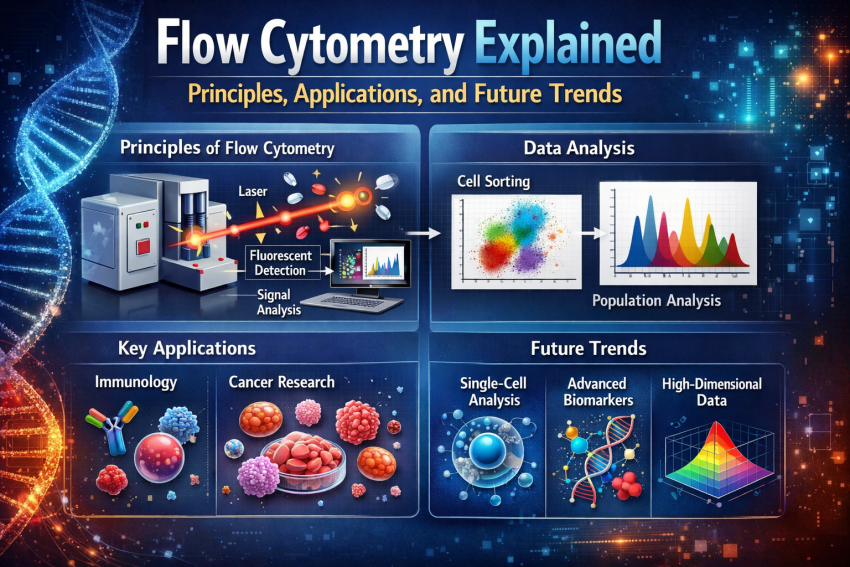
Flow cytometry is a powerful analytical technology used to measure and analyze the physical and chemical characteristics of cells or particles in a fluid suspension. Widely applied in immunology, oncology, clinical diagnostics, and drug discovery, this technique enables scientists to analyze thousands of cells per second with exceptional precision.
By combining laser technology, fluorescent markers, and advanced data analysis, flow cytometry provides detailed insights into cell populations, helping researchers better understand disease mechanisms, immune responses, and cellular functions. As the demand for single-cell analysis and precision medicine grows, flow cytometry continues to play a crucial role in modern biomedical research.
Download PDF Brochure: https://www.marketsandmarkets.com/pdfdownloadNew.asp?id=65374584
What is Flow Cytometry?
Flow cytometry is a laser-based technology used to detect and measure multiple physical characteristics of single cells or particles while they flow through a fluid stream.
Cells are typically labeled with fluorescent antibodies or dyes that bind to specific proteins or cellular components. When these labeled cells pass through the laser beam, they emit light signals that are detected and analyzed by the instrument.
This process allows researchers to measure parameters such as:
- Cell size
- Cell complexity or granularity
- Protein expression levels
- Cell viability
- DNA or RNA content
The technology is essential for characterizing heterogeneous cell populations, making it a cornerstone tool in life sciences and medical diagnostics.
Key Principles of Flow Cytometry
- Fluidics System
The fluidics system transports cells in a single-file stream through the laser beam. This ensures that each cell is analyzed individually.
- Optical System
The optical system includes lasers and detectors. When cells pass through the laser beam, they scatter light and emit fluorescence signals.
Two main light signals are measured:
- Forward Scatter (FSC): Indicates cell size
- Side Scatter (SSC): Reflects internal cell complexity
- Fluorescence Detection
Cells labeled with fluorescent dyes emit light at specific wavelengths when excited by the laser. Detectors capture these signals to determine protein expression or molecular markers.
- Data Processing
Signals are converted into digital data and analyzed using specialized software. Researchers visualize results in histograms, dot plots, and density plots to identify distinct cell populations.
Major Applications of Flow Cytometry
Immunology Research
Flow cytometry is widely used to analyze immune cell populations, including T cells, B cells, and natural killer cells. This helps researchers understand immune responses, vaccine efficacy, and autoimmune disorders.
Cancer Diagnosis and Monitoring
In oncology, flow cytometry assists in detecting abnormal cell populations and diagnosing hematological malignancies such as leukemia and lymphoma. It also helps monitor treatment responses.
Clinical Diagnostics
Clinical laboratories use flow cytometry for applications such as:
- HIV monitoring (CD4 cell counting)
- Detection of immune deficiencies
- Transplant compatibility testing
Drug Discovery and Development
Pharmaceutical companies rely on flow cytometry for high-throughput screening, toxicity testing, and biomarker discovery, accelerating the drug development process.
Stem Cell Research
The technology is critical for identifying and isolating rare stem cell populations, supporting regenerative medicine research.
Advantages of Flow Cytometry
Flow cytometry offers several benefits that make it indispensable in modern research and diagnostics:
- High throughput: Analyzes thousands of cells per second
- Multiparametric analysis: Measures multiple cellular characteristics simultaneously
- Single-cell resolution: Enables detailed analysis of individual cells
- Quantitative results: Provides precise measurements of molecular markers
These advantages allow scientists to gain deeper insights into complex biological systems.
Limitations of Flow Cytometry
Despite its strengths, flow cytometry also has some limitations:
- Requires specialized equipment and trained personnel
- Sample preparation can be complex
- Data analysis may require advanced computational tools
However, continuous technological improvements are helping overcome many of these challenges.
Future Trends in Flow Cytometry
High-Dimensional Flow Cytometry
Modern instruments can analyze 20–40 parameters simultaneously, enabling deeper insights into cellular complexity.
Integration with Artificial Intelligence
AI and machine learning are increasingly used to automate data analysis and identify rare cell populations.
Spectral Flow Cytometry
Spectral flow cytometry improves fluorescence detection by capturing full emission spectra, allowing researchers to use more markers simultaneously.
Single-Cell Multi-omics
Future platforms may integrate flow cytometry with genomics, transcriptomics, and proteomics, offering a more comprehensive understanding of cellular biology.
Automation and High-Throughput Systems
Automation is making flow cytometry faster and more scalable, supporting large-scale clinical and pharmaceutical research.
Conclusion
Flow cytometry has become an essential tool for cell analysis, disease diagnosis, and biomedical research. Its ability to rapidly analyze thousands of cells while measuring multiple parameters has transformed fields such as immunology, oncology, and drug development.
With advances in AI integration, spectral technologies, and single-cell analysis, the future of flow cytometry promises even greater precision and deeper biological insights. As research continues to evolve, flow cytometry will remain a cornerstone technology driving innovation in life sciences and healthcare.
Request Sample Pages: https://www.marketsandmarkets.com/requestsampleNew.asp?id=65374584