
The Fab Automation Market Surges with Next-Generation Process Control and Smart Factory Integration as semiconductor manufacturers increasingly adopt advanced automation technologies to enhance production efficiency, reduce costs, and improve product quality. With the growing demand for high-performance chips across industries such as electronics, automotive, telecommunications, and industrial applications, fab automation has become a critical component in modern semiconductor fabrication plants.
Drivers of Fab Automation Market Growth
One of the primary factors fueling the Fab Automation Market Surges with Next-Generation Process Control and Smart Factory Integration is the rising complexity of semiconductor devices. As chips become smaller, more intricate, and higher in performance, traditional manual processes are no longer sufficient. Automated wafer handling, lithography, etching, and inspection systems are essential to maintain precision, minimize defects, and ensure consistent quality in high-volume manufacturing.
Advanced process control (APC) technologies are also accelerating Fab Automation Market Surges with Next-Generation Process Control and Smart Factory Integration. APC systems use real-time data from production equipment to monitor and optimize processes, enabling manufacturers to reduce variability, improve yield, and enhance overall equipment effectiveness (OEE). Integration of machine learning and predictive analytics into APC systems further supports smarter decision-making and proactive maintenance in semiconductor fabs.
Download PDF Brochure @ https://www.marketsandmarkets.com/pdfdownloadNew.asp?id=219676619
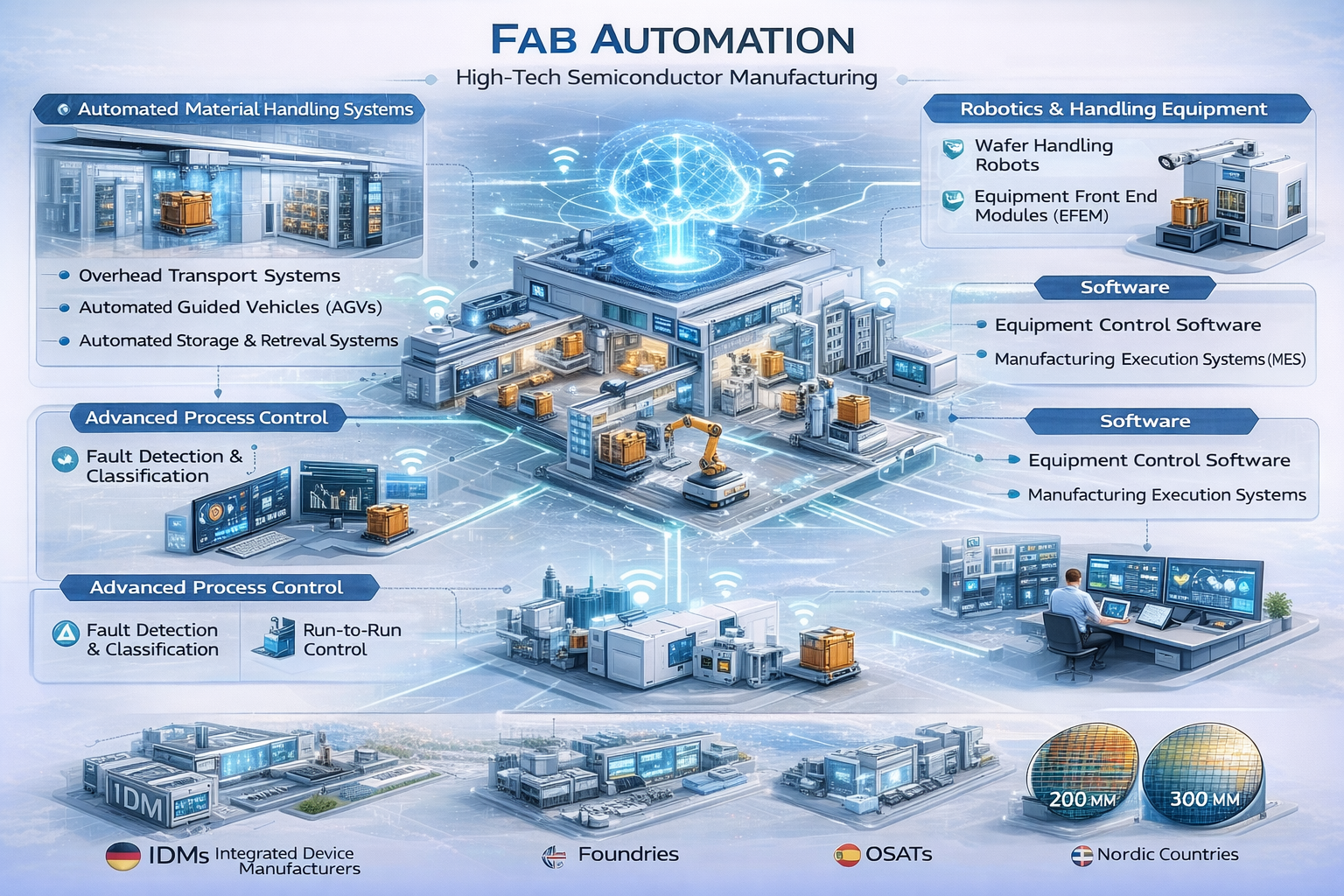
Smart Factory Integration
The adoption of smart factory concepts is another major driver behind Fab Automation Market Surges with Next-Generation Process Control and Smart Factory Integration. Smart fabs leverage interconnected equipment, IoT-enabled sensors, and centralized data platforms to create highly automated and self-optimizing production environments. This integration allows manufacturers to monitor production lines remotely, quickly respond to issues, and optimize throughput without compromising quality. As semiconductor demand grows, the need for fully automated, data-driven fabs continues to propel market growth.
Robotics and automated material handling systems are also contributing to Fab Automation Market Surges with Next-Generation Process Control and Smart Factory Integration. Automated guided vehicles (AGVs), robotic wafer transfer systems, and smart storage solutions reduce human intervention, improve safety, and ensure precise handling of fragile wafers. These solutions not only enhance operational efficiency but also reduce labor costs and minimize contamination risks in highly sensitive fabrication environments.
Regional Insights
Geographically, North America and East Asia are leading regions for fab automation adoption. North America, particularly the United States, is home to major semiconductor manufacturers and innovators in automation technologies. Meanwhile, East Asia, led by countries such as Taiwan, South Korea, and Japan, dominates global semiconductor production, driving significant demand for automation solutions to enhance production capacity and efficiency. Europe is also experiencing steady growth as semiconductor manufacturers modernize existing fabs and integrate Industry 4.0 technologies.
Challenges in the Fab Automation Market
Despite strong growth prospects, the Fab Automation Market Surges with Next-Generation Process Control and Smart Factory Integration faces several challenges. High initial investment costs, the complexity of integrating automation with legacy systems, and ongoing maintenance requirements can pose barriers for some manufacturers. Additionally, the shortage of skilled personnel for programming, operating, and maintaining automated systems remains a concern. However, continuous innovation, modular automation solutions, and collaborative robotics are helping manufacturers overcome these challenges and drive adoption.
Future Outlook
Looking ahead, the Fab Automation Market Surges with Next-Generation Process Control and Smart Factory Integration as the semiconductor industry continues to expand. Emerging trends such as AI-driven process optimization, real-time monitoring, predictive maintenance, and fully autonomous production lines are expected to further strengthen market growth. With increasing investments in wafer fabs, next-generation chip technologies, and high-volume production facilities, fab automation will remain a cornerstone for achieving efficiency, precision, and scalability in semiconductor manufacturing.
In conclusion, the Fab Automation Market Surges with Next-Generation Process Control and Smart Factory Integration, highlighting the importance of automation in meeting the global demand for advanced semiconductor devices. By integrating smart factory concepts, advanced process control, and robotics, semiconductor manufacturers are optimizing production, improving yields, and preparing for the next generation of chip technologies.
FAQ
1. What is fab automation?
Fab automation refers to the use of automated systems, robotics, and software solutions in semiconductor fabrication plants to streamline production processes, improve precision, and enhance operational efficiency.
2. What is driving the growth of the Fab Automation Market?
The market is primarily driven by increasing demand for high-performance semiconductors, growing complexity of chip manufacturing, adoption of advanced process control (APC) systems, and the integration of smart factory technologies.
3. What are the key applications of fab automation?
Fab automation is widely used for:
- Wafer handling and transfer
- Lithography, etching, and deposition processes
- Inspection and testing of semiconductor devices
- Material storage and logistics within the fab
4. Which technologies are prominent in fab automation?
Key technologies include:
Advanced Process Control (APC) – for real-time optimization of fab processes
Robotics and AGVs – for automated wafer handling and material movement
Smart Factory Integration – IoT-enabled sensors, centralized monitoring, and AI-based analytics
5. Which industries drive demand for fab automation?
The semiconductor and electronics industries are the largest users of fab automation, including manufacturers of memory chips, processors, automotive ICs, and other advanced semiconductor devices.
About MarketsandMarkets™
MarketsandMarkets™ is a blue ocean alternative in growth consulting and program management, leveraging a man-machine offering to drive supernormal growth for progressive organizations in the B2B space. We have the widest lens on emerging technologies, making us proficient in co-creating supernormal growth for clients.
The B2B economy is witnessing the emergence of $25 trillion of new revenue streams that are substituting existing revenue streams in this decade alone. We work with clients on growth programs, helping them monetize this $25 trillion opportunity through our service lines – TAM Expansion, Go-to-Market (GTM) Strategy to Execution, Market Share Gain, Account Enablement, and Thought Leadership Marketing.
Built on the ’GIVE Growth’ principle, we work with several Forbes Global 2000 B2B companies – helping them stay relevant in a disruptive ecosystem. Our insights and strategies are molded by our industry experts, cutting-edge AI-powered Market Intelligence Cloud, and years of research. The KnowledgeStore™ (our Market Intelligence Cloud) integrates our research, facilitates an analysis of interconnections through a set of applications, helping clients look at the entire ecosystem and understand the revenue shifts happening in their industry.
To find out more, visit www.MarketsandMarkets™.com or follow us on Twitter, LinkedIn and Facebook.
Contact:
Mr. Rohan Salgarkar
MarketsandMarkets™ INC.
630 Dundee Road
Suite 430
Northbrook, IL 60062
USA : 1-888-600-6441