
According to a research report published by MarketsandMarkets, the global agricultural calcium market is projected to grow from USD 23.60 billion in 2025 to USD 29.62 billion by 2030, registering a Compound Annual Growth Rate (CAGR) of 4.6% during the forecast period.
Rising Importance of Calcium in Modern Agriculture
The agricultural calcium market is witnessing steady growth as farming practices continue to evolve. Farmers are increasingly focusing on soil restoration, pH correction, and livestock nutrition to maintain productivity and sustainability.
Intensive farming practices often lead to nutrient depletion and soil acidity, particularly in field crops and horticulture. Calcium-based products such as calcium carbonate and agricultural lime play a crucial role in restoring soil health. These inputs help improve soil structure, enhance nutrient absorption, and stabilize pH levels, enabling crops to grow more efficiently.
Request Custom Data to Address your Specific Business Needs
At the same time, the livestock sector relies heavily on feed-grade calcium to support animal health and productivity. Poultry and dairy farms use calcium supplements to improve bone strength, eggshell quality, milk yield, and feed efficiency.
As farmers move toward clean-label mineral inputs and sustainable farming solutions, calcium has emerged as a vital agricultural input. Its dual role in soil treatment and animal feed nutrition continues to drive consistent demand across global agricultural systems.
South America Emerging as the Fastest-Growing Regional Market
South America is expected to become the fastest-growing region in the agricultural calcium industry during the forecast period. The region’s agricultural expansion across diverse climate zones is creating strong demand for soil conditioning and livestock nutrition inputs.
Tropical countries such as Brazil, Colombia, and Ecuador cultivate high-value crops including coffee, cacao, bananas, mangoes, and pineapples. These crops often grow in acidic soils that require calcium-based solutions such as agricultural lime and calcium carbonate to correct soil pH and improve soil structure.
Meanwhile, temperate agricultural regions such as Chile, Argentina, and the Pampas focus on large-scale production of soybeans, corn, wheat, and sugarcane. Continuous cropping in these regions often reduces soil nutrients, making calcium supplementation essential for maintaining productivity and nutrient balance.
The Pampas and surrounding regions also host major beef and dairy industries, where feed-grade calcium is widely used to enhance bone development, milk production, and feed efficiency.
As South America continues expanding its crop exports, livestock production, and agribusiness infrastructure, calcium-based agricultural inputs are becoming essential for maintaining soil productivity and supporting animal nutrition.
Powder Form Dominates the Agricultural Calcium Market
By form, the powder segment is expected to hold the largest market share throughout the forecast period.
Powder-based calcium products remain the most widely used format across agricultural applications due to their ease of use and versatility. In crop production, powder products such as agricultural lime and calcium carbonate are easy to spread across fields and react quickly to improve soil pH and structure.
In animal nutrition, powder calcium blends seamlessly into compound feed formulations, allowing consistent dosage and improved nutrient absorption.
Another key advantage of powder formulations is lower processing costs compared to granules or liquid forms, making them more affordable for large-scale farming operations. Because of their practical handling, cost-effectiveness, and wide availability, powder calcium products continue to dominate the market.
Natural Mineral Calcium Gaining Momentum
Among different calcium types, the natural mineral segment is expected to register the fastest growth during the forecast period.
Farmers are increasingly choosing naturally sourced mineral inputs that are minimally processed and environmentally sustainable. Products such as Azomite, Kelzyme, and other natural mineral calcium sources are commonly used in agriculture as rock dust or fossil-based calcium materials.
These natural minerals help improve soil structure, maintain pH balance, and enhance long-term soil fertility. They also supply trace minerals that support plant growth and nutrient uptake.
In livestock nutrition, natural mineral calcium contributes to stronger bones, improved eggshell quality, and better milk production, while reducing reliance on synthetic additives.
With the global shift toward organic and regenerative agriculture, demand for natural mineral calcium solutions is expected to grow significantly.
Key Companies in the Agricultural Calcium Market
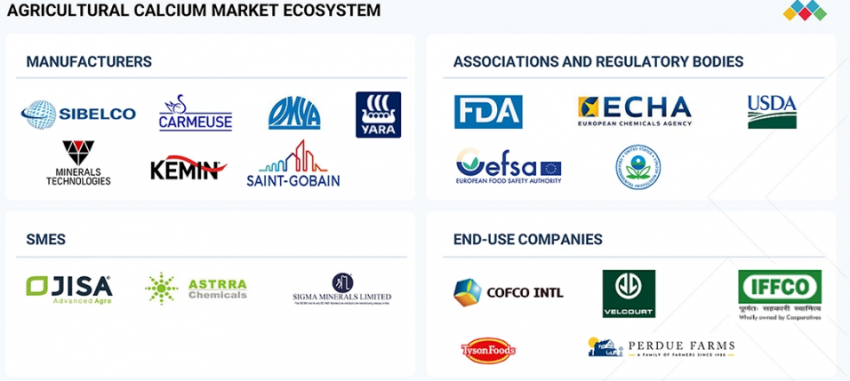
The report highlights several agricultural calcium players operating in the global market, including Yara International (Norway), Omya International AG (Switzerland), Sibelco (US), Carmeuse (Belgium), Coromandel International Ltd. (India), Imerys (France), Saint-Gobain Formula (UK), Minerals Technologies Inc. (US), Graymont (Canada), Kemin Industries, Inc. (US), CALC Group (Poland), EuroChem Group (Switzerland), GLC Minerals, LLC. (US), Huber Engineered Materials (US), Mississippi Lime Company d/b/a MLC (US), AZOMITE Mineral Products, Inc. (US), Jiloca Industrial SA (Spain), Sigma Minerals Ltd. (India), Astrra Chemicals (India), and Lhoist (Belgium), among others.