
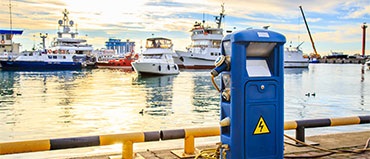
The Asia Pacific Shore Power Market size is projected to be valued at USD 0.80 billion in 2025 and USD 1.56 billion by 2030, registering a CAGR of 14.2% between 2025 and 2030. One of the major factors driving the Asia Pacific shore power market is the stringent environmental policies to help minimize emissions from ships parked in ports. Major economies, including China, Japan, South Korea, and Singapore, adopt strict air emissions policies and a policy of decarbonization, hence encouraging ports in these economies to use cleaner technology. Shore power has been cited as a popular alternative since it has a major impact on reducing emissions of sulfur oxides, nitrogen oxides, and particulates from auxiliary engines. Additionally, governments in these economies provide incentives in the form of shore power projects, making it additionally profitable for terminals and carriers to make use of shore power. Being close to major metropolitan areas, environmental concerns related to air emissions are a major priority for ports in the region.
Download PDF Brochure: https://www.marketsandmarkets.com/pdfdownloadNew.asp?id=217608388
Retrofit segment is expected to capture the largest market share during the forecast period.
The retrofit segment is expected to hold the largest share of the Asia Pacific shore power market, as most vessels operating in the region are originally built with shore-power capability, creating a large and immediate need for retrofitting. With the rising implementation of stringent emissions policies, ship owners are also opting for retrofitted shore power in their ships to comply with these policies. Retrofitting also has a faster payback period compared with ship replacement. With the increasing port development, ships also must be able to provide shore power connectivity to secure preferred docking slots.
Frequency converters segment is projected to witness a significant growth rate between 2025 and 2030.
The frequency converters segment is projected to grow in the Asia Pacific shore power market during the forecast period. The difference in power frequencies for ships and shore stations has led to the increasing use of shore-based shore-power conversion technology. This has been attributed to the different frequencies of 50 Hz and 60 Hz maintained by ships and shore stations, which are not ideally synchronized for a consistent flow of uninterrupted shore-based electricity. Ports in other Asian nations, including Singapore, also make use of shore-based shore-power technology.
Japan is likely to account for the second-largest market share in 2030.
Japan is expected to be the second-largest country in the Asia Pacific shore power market in 2030, supported by its advanced port infrastructure and strong commitment to environmental sustainability. Major ports, such as Tokyo, Yokohama, and Kobe, are increasingly adopting shore power systems to reduce emissions from vessels at berth and comply with national decarbonization goals. The focus on lowering greenhouse gas emissions from maritime transport, combined with government support for green port initiatives, boosts shore power deployment. Additionally, the emphasis on technological reliability, grid stability, and standardization enables smooth integration of high-voltage shore connection systems, reinforcing its strong position in the Asia Pacific shore power market.
Request Sample Pages: https://www.marketsandmarkets.com/requestsampleNew.asp?id=217608388
The Asia Pacific shore power market is dominated by major players that have a wide regional presence. Some key players in the Asia Pacific shore power market are ABB (Switzerland), Siemens (Germany), Schneider Electric (France), GE (US), Cavotec SA (Switzerland), Eaton (Ireland), Wartsila (Finland), and Hitachi Energy Ltd. (Switzerland).
General Electric
General Electric Company demonstrates a strong market presence through strategic focus on energy transition, advanced electrification technologies, and modernization of grid infrastructure, which directly supports its participation in the shore power market. The company’s core competencies lie in high-efficiency power generation systems, grid integration solutions, and long-established engineering expertise, enabling it to deliver reliable shore-to-ship electrification components through its Power segment. The company has a history of major activities, such as acquisitions, strategic partnerships, and technology collaborations, that strengthen its portfolio across aerospace and energy verticals. It also benefits from extensive horizontal integration across power, renewable energy, and grid technologies, which enhances scalability and service capability in the shore power ecosystem.
Siemens
Siemens has a robust footprint with a focused approach on digitalization, automation, energy transition, and infrastructure, which helps the company cater to increasing demands in the area of electrification solutions, including shoreside power. The company’s core competencies range from leading-edge industrial automation, intelligent energy solutions, grid solutions, and electrification solutions offered by Digital Industries and Smart Infrastructure businesses, making it a major shore power solution supplier. It has been involved in a host of key activities, such as acquisitions, technology collaborations, and joint ventures aimed at enhancing knowledge in automation, mobility, and energy management, in addition to diversifying its portfolios. In addition, it derives huge benefits from their integrated horizontal networks in automation, energy, mobility, and healthcare technology, as well as vertical integration in manufacturing, engineering, and finance offered by their related company, Siemens Financial Services. With nearly 500 distribution channels and 9,000 dealership offices in over 190 nations, it derives benefits from its integrated network for executing mega projects in shore power.