
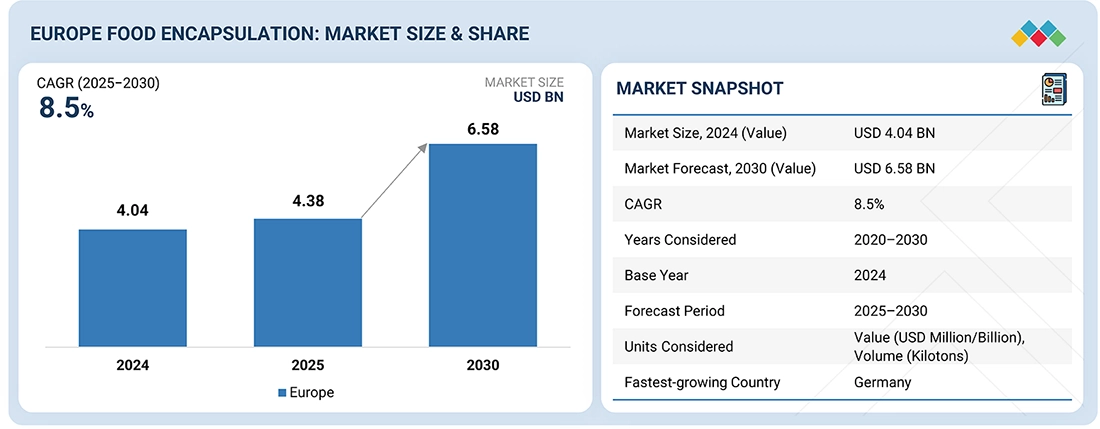
The Europe food encapsulation market is on a steady growth trajectory, driven by rising demand for product stability, extended shelf life, and enhanced ingredient performance. According to MarketsandMarkets™, the market is expected to grow from USD 4.38 billion in 2025 to USD 6.58 billion by 2030, registering a CAGR of 8.5% during the forecast period.
Food and ingredient manufacturers across Europe are increasingly adopting encapsulation technologies to meet evolving consumer expectations around quality, functionality, and clean-label formulations.
Why Food Encapsulation Is Gaining Momentum in Europe
Food encapsulation has become a critical solution for protecting sensitive ingredients such as vitamins, minerals, probiotics, antioxidants, and enzymes. By surrounding these active components with protective coatings, encapsulation helps shield them from heat, moisture, and oxygen, ensuring consistent performance throughout processing, storage, and consumption.
This technology has found widespread application across the food, nutrition, and pharmaceutical industries, where maintaining ingredient integrity and controlled release is essential. As a result, encapsulation is now a cornerstone of modern food innovation in Europe.
Download PDF Brochure: https://www.marketsandmarkets.com/pdfdownloadNew.asp?id=220568560
Key Markets and Technology Advancements Driving Growth
Major European countries—including Germany, France, the United Kingdom, Italy, Spain, and the Nordic nations—are playing a central role in driving market demand. Manufacturers in these regions prioritize clean-label compliance, product quality, and longer shelf life, which strongly aligns with encapsulation benefits.
Technological advancements such as spray drying, coacervation, extrusion, and lipid-based encapsulation systems are further supporting market expansion. These methods allow for improved absorption, controlled ingredient release, and enhanced stability, making them ideal for functional and fortified food applications. Growing consumer interest in nutrition-focused foods continues to reinforce adoption across the region.
Nanoencapsulation: The Fastest-Growing Technology Segment
Among encapsulation technologies, nanoencapsulation is projected to experience the fastest growth in the European market. Its ability to enhance bioavailability and precisely control the release of flavors, vitamins, antioxidants, enzymes, and probiotics makes it particularly attractive for premium and functional food products.
Nanoencapsulation also aligns well with Europe’s emphasis on clean-label and high-performance formulations, helping manufacturers overcome taste-masking challenges and extend shelf life. While cost remains higher compared to traditional methods, ongoing advancements in process efficiency and scaling are steadily improving commercial viability. Strong collaboration between food brands, research institutions, and technology providers is accelerating adoption across Europe.
Functional Foods Dominate Market Applications
Functional foods represent a significant share of the Europe food encapsulation market. Encapsulation enables manufacturers to fortify everyday foods with health-promoting ingredients without compromising stability or sensory appeal.
European consumers increasingly seek products that support immunity, digestion, energy, and overall wellness, driving demand for fortified dairy products, cereals, bakery items, and nutrition bars. Encapsulation helps brands meet both functional performance and clean-label expectations, while Europe’s robust retail infrastructure and harmonized food regulations further encourage market penetration.
Request Sample Pages: https://www.marketsandmarkets.com/requestsampleNew.asp?id=220568560
Germany Leads the European Market
On a country level, Germany holds a leading position in the Europe food encapsulation market. The country’s large and well-established food and beverage industry extensively applies encapsulation technologies across functional foods, dairy, bakery, and nutritional products.
Germany benefits from advanced food processing capabilities, strong investment in food research and development, and close collaboration between manufacturers, ingredient suppliers, and research institutions. High consumer awareness around health, transparency, and product quality—combined with strict food safety standards and efficient supply chains—continues to drive demand for encapsulated ingredients.
Key Players Shaping the Europe Food Encapsulation Market
The European market features several prominent global and regional players, including-
- BASF SE (Germany)
- Kerry Group plc (Ireland)
- DSM-Firmenich (Switzerland)
- Givaudan (Switzerland)
- Symrise (Germany)
- Lonza (Switzerland)
- Evonik (Germany)
- Lallemand Inc. (Canada)
- Firmenich SA (Switzerland)
- Sensient Technologies Corporation (US)
These companies continue to invest in innovation, partnerships, and advanced encapsulation technologies to meet growing demand across Europe.
Outlook: Encapsulation as a Key Enabler of Food Innovation
As Europe’s food industry increasingly shifts toward value-added, functional, and performance-driven products, food encapsulation is expected to remain a vital technology. With continued advancements in encapsulation methods and rising consumer demand for fortified and clean-label foods, the Europe food encapsulation market is well-positioned for sustained growth through 2030.