
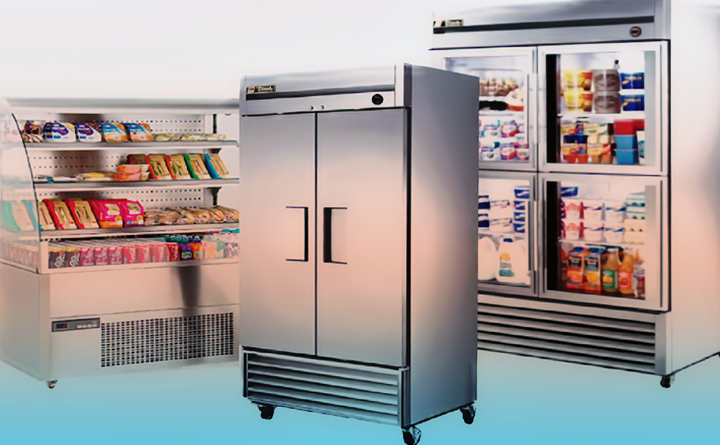
The global commercial refrigeration market is projected to grow from USD 51.26 billion in 2025 to USD 67.31 billion by 2030, at a CAGR of 5.6% during the forecast period. The report examines critical elements such as market dynamics, evolving technologies, segmentation with commercial refrigeration market trends, regional developments, and the competitive landscape. The commercial refrigeration market is growing worldwide due to rising demand for reliable cold-storage systems across food retail, hospitality, pharmaceuticals, and logistics. Expanding modern retail formats, greater consumer focus on fresh and safely preserved products, and the rapid development of cold-chain networks are all increasing the need for efficient and consistent cooling solutions. Global trade in perishable goods and temperature-sensitive medical supplies further strengthens this demand, while advancements in refrigeration technologies, energy efficiency, and digital monitoring encourage businesses to upgrade existing equipment.
Download PDF Brochure: https://www.marketsandmarkets.com/pdfdownloadNew.asp?id=189269432
By product type, the transportation refrigeration cases segment is estimated to account for the largest market share, in terms of value, during the forecast period.
Transportation refrigeration is estimated to account for the largest share of the commercial refrigeration market due to the rapid expansion of global trade in perishable goods and the rising demand for temperature-controlled logistics. The increasing consumption of frozen food, dairy, meat, seafood, and pharmaceutical products that require precise temperature management during transit is driving the need for advanced refrigerated trucks, trailers, containers, and railcars. Growth in e-commerce grocery delivery and cross-border food exports has further intensified the requirement for reliable cold chain transportation systems.
By refrigerant type, the fluorocarbons segment is expected to account for the largest market share, in terms of value, during the forecast period.
The fluorocarbons segment is estimated to account for the largest share in the commercial refrigeration market due to their widespread availability, high efficiency, and strong cooling performance across a variety of applications. These refrigerants, including hydrofluorocarbons (HFCs) and hydrochlorofluorocarbons (HCFCs), have long been preferred for their thermodynamic stability, nonflammability, and compatibility with existing refrigeration systems. Despite increasing environmental regulations, the continued use of fluorocarbons in regions with less stringent emission standards and in industries requiring high-capacity cooling, such as supermarkets, cold storage, and transportation refrigeration, has sustained their strong market demand.
By application, the food services segment is estimated to account for the largest market share, in terms of value, during the forecast period.
The food services segment is estimated to account for the largest share in the commercial refrigeration market due to the rapid expansion of restaurants, cafeterias, cloud kitchens, and quick-service outlets worldwide. Rising consumer preference for dining out and the surge in online food delivery platforms are driving the demand for large-scale cold storage and display solutions. Additionally, stringent food safety regulations and the growing need to maintain freshness and quality across diverse menu offerings have led to increased adoption of advanced refrigeration systems.
Get a Sample Copy of This Report: https://www.marketsandmarkets.com/requestsampleNew.asp?id=189269432
By end use, the supermarkets & hypermarkets segment is estimated to account for the largest market share, in terms of value, during the forecast period.
The supermarkets & hypermarkets segment is estimated to account for the largest share in the commercial refrigeration market due to several key factors. The rapid expansion of retail chains increases the need for advanced refrigeration solutions that enable efficient storage, display, and preservation of a wide variety of perishable products such as dairy, meats, seafood, and frozen foods. Additionally, shifting consumer preferences toward fresh and convenient ready-to-eat foods, coupled with higher disposable incomes and fast-paced lifestyles, are driving demand for larger, high-performance refrigeration systems in these settings.
Asia Pacific is projected to account for the largest market share during the forecast period in terms of value.
The Asia Pacific region is estimated to account for the largest share in the global commercial refrigeration market due to its rapidly expanding retail and food service sectors, strong economic growth, and increasing urbanization. Rising disposable incomes and changing consumer lifestyles are fueling demand for frozen and processed foods, driving the need for advanced refrigeration systems in supermarkets, restaurants, and convenience stores. Countries such as China, India, Japan, and South Korea are experiencing significant investments in cold chain infrastructure to support food distribution, pharmaceutical storage, and export activities.
Commercial Refrigeration Companies
Some of the leading players in this market include Daikin (Japan), Johnson Controls (US), Hussmann Corporation (US), Danfoss (Denmark), Dover Corporation (US), Haier Inc. (China), and EPTA Corporate (Italy).
Daikin (Japan)
Daikin is one of the leading manufacturers in the building-climate space, with a broad portfolio that spans heating, ventilation, air-conditioning, and refrigeration systems. The company is structured to offer end-to-end solutions from designing and producing core components to delivering integrated climate systems and service support. Its business model reflects a balance between technical depth and global reach, ensuring that its offerings are adapted to a variety of markets and customer requirements.
Inquire Before Buying: https://www.marketsandmarkets.com/Enquiry_Before_BuyingNew.asp?id=189269432
Johnson Controls (US)
Johnson Controls is a global company that specializes in creating environments that are safe, healthy, and sustainable. It offers a broad range of building technologies, digital services, and integrated systems that span refrigeration, HVAC, controls, fire, and security. The company’s approach emphasises lifecycle support, operational efficiency, and adaptability to complex building-and-industrial contexts, serving customers in commercial, institutional, and industrial settings.
Hussmann Corporation (US)
Hussmann Corporation is one of the leading providers of commercial refrigeration and display merchandising solutions for retail and food service industries. The company operates as a subsidiary of Panasonic Corporation following its acquisition in 2016. The company focuses on providing innovative technologies that help retailers maintain product quality, enhance energy efficiency, and optimize store performance. Its operations extend across multiple regions, serving supermarkets, convenience stores, and food service sectors with reliable and sustainable refrigeration solutions.
Recent Developments
January 2025 : The company announced the launch of its new TrilliumSeries Dry Cooler, designed to meet the increasing demand for sustainable and water-efficient cooling solutions.
June 2024 : Armacell acquired the engineering business of E&M Industries, a Western Australia-based specialist in thermal and acoustic insulation jacketing systems. Operating under Armacell Australia Engineering Pty Ltd., the acquisition strengthens Armacell’s presence in the Asia Pacific insulation market and supports its strategic expansion into energy-efficient and industrial insulation solutions, including applications for data centers and energy infrastructure. The transaction enhances Armacell’s capabilities in fabrication, energy-saving technologies, and solution-based insulation offerings.